How to Read a Pay Stub, Line by Line
Updated on Sep 23, 2026By CalculatNow Editorial Team13 min read
A pay stub is the receipt for your own labour, and most people never read past the number at the bottom. Everything above it explains where the rest went — and roughly one in five stubs contains something worth querying. This walks the document from the top, using a real one.
Calculators for this topic
Read it in three passes: what you earned, what was taken out, and what is left. Every pay stub in the United States is some arrangement of those three blocks, however unfamiliar the layout looks.
Key takeaways
- Gross is what you earned. Net is what arrives. The gap is deductions, and every one of them should be itemised.
- FICA is not one tax. It is Social Security at 6.2% and Medicare at 1.45%, listed separately on a good stub.
- No federal law makes your employer give you a stub. Most states require one; federal law only requires the records behind it.
- The YTD column is the one to check. A single period can look right while the running total is wrong.
- Pre-tax deductions cut your taxable pay. That is why gross minus deductions rarely equals the figure tax was calculated on.
What is a pay stub, and does your employer have to give you one?
A pay stub is the itemised statement that comes with your wages, showing what you earned in a pay period and every amount subtracted from it. You may see it called an earnings statement, a wage statement, a payslip or a check stub. They are the same document.
Here is the part that surprises people: no federal law requires your employer to give you one. The Fair Labor Standards Act requires employers to keep records — fourteen specific items, including hours worked each day, the basis of pay, all additions and deductions, and the date of payment — but it stops at keeping them. Handing you a statement is a state matter, and most states do require it, in varying detail.
Key point
If you do not receive a stub, ask payroll for one in writing. The employer already holds every figure on it, because federal recordkeeping rules oblige them to.
The header block: who you are and what period this covers
The top strip is identification, and it is worth thirty seconds because two of its fields decide whether the rest of the document makes sense.
- Employee name, address and a partial Social Security number. Only the last four digits should appear. A full SSN on a stub is a data-protection problem, not a formatting choice.
- Pay period — the span of work being paid for. On the example below, 07/07 to 07/13: a single week.
- Pay date — when the money actually moves. Almost always after the period ends, which is why your first stub in a new job covers less than you expected.
- Check or advice number, and often an employee number. These are what payroll will ask for if you query anything.
The pay period and the pay date are different things, and conflating them causes most of the confusion about a first or last paycheck. Work done in the final week of a job is usually paid on the following cycle, not on your last day.
How often you are paid changes the size of each stub but not your annual pay — and it changes how many stubs you should have by the end of the year.
| Pay frequency | Stubs per year | A $52,000 salary arrives as |
|---|---|---|
| Weekly | 52 | $1,000.00 |
| Every two weeks (biweekly) | 26, occasionally 27 | $2,000.00 |
| Twice a month (semi-monthly) | 24 | $2,166.67 |
| Monthly | 12 | $4,333.33 |
Biweekly and semi-monthly are not the same, and people lose money assuming they are. Biweekly means every fourteen days, which lands 26 times a year and occasionally 27. Semi-monthly means twice a month, always 24. Two jobs quoting the same annual figure pay different amounts per stub.
Gross pay: what you earned before anything came out
Gross pay is the full amount you earned in the period, before a single deduction. For hourly work it is your rate times your hours. For salaried work it is your annual salary divided by the number of pay periods.
A well-built stub breaks gross pay into its parts rather than giving one number: regular hours at one rate, overtime at another, then any bonus, commission, tips or shift differential on their own lines. If you worked overtime and cannot see it itemised, that is the first thing to query — the overtime calculator will tell you what the line should say.
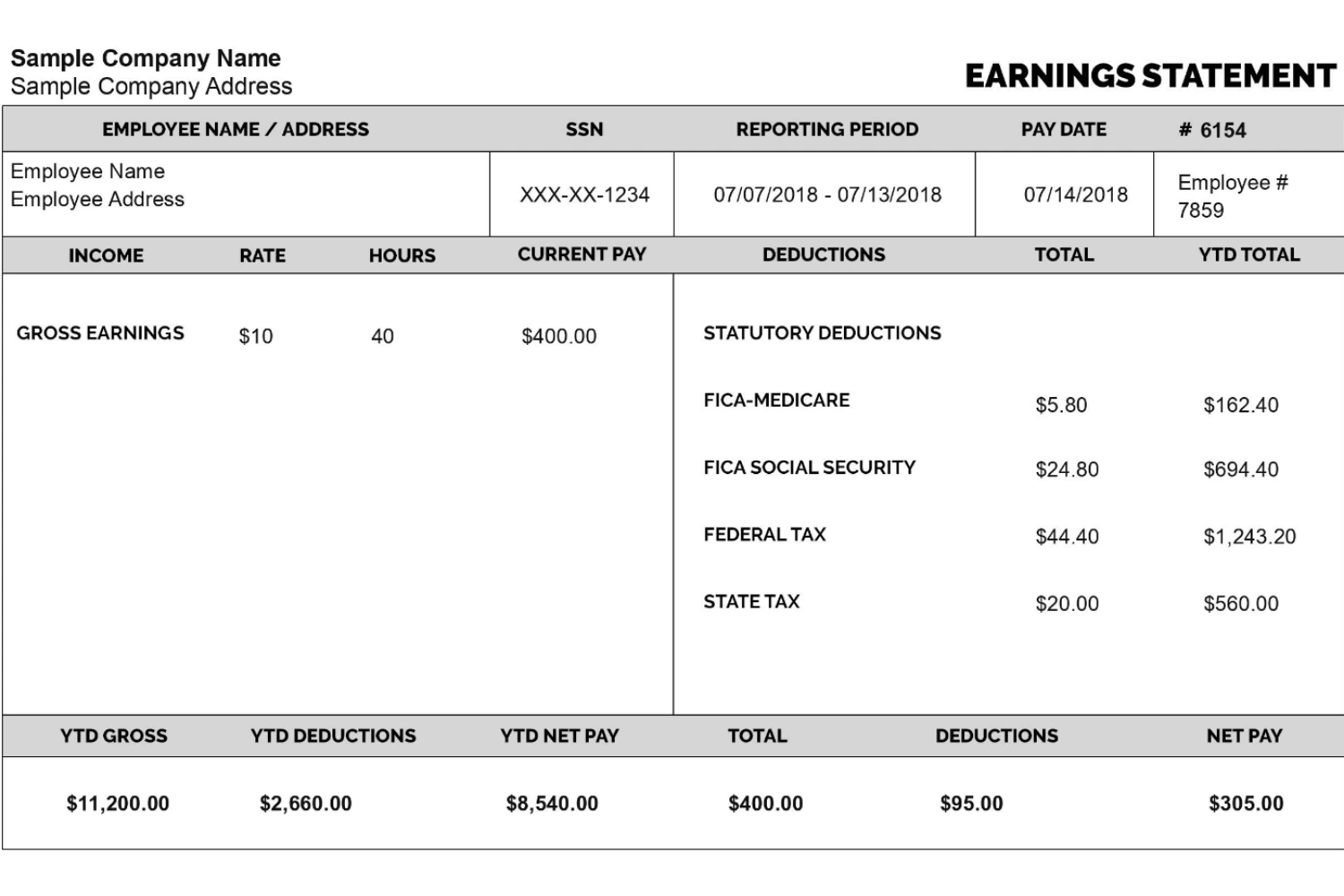
That is the stub this guide works through. Someone paid $10 an hour for 40 hours, so gross pay is $400.00. Earnings sit on the left, deductions on the right, and the totals run along the bottom — which is the layout most American stubs use, however differently they style it.
The deductions block: where the money actually went
This is the half of the document people skip, and it is the half worth reading. Deductions divide into taxes you cannot avoid, and everything else.
FICA: Social Security and Medicare
FICA stands for the Federal Insurance Contributions Act, and it is two separate taxes, not one. Some stubs list them together as "FICA", which hides useful detail. The example splits them properly.
These rates are fixed by law, identical for everyone, and unaffected by how you fill in a W-4 — which is what makes them the easiest lines to check.
| Line | 2026 rate | Applies to | On $400 gross |
|---|---|---|---|
| FICA Social Security (OASDI) | 6.2% | Wages up to $184,500 a year | $24.80 |
| FICA Medicare | 1.45% | Every dollar, no ceiling | $5.80 |
| Additional Medicare | 0.9% | Wages above $200,000 | — |
Multiply $400 by 6.2% and you get $24.80. Multiply it by 1.45% and you get $5.80. Both match the stub exactly, which is the point: these two lines either compute or they do not.
Your employer pays the same amounts again, separately, out of its own money — 6.2% and 1.45% matched. That contribution never appears on your stub, which is why the true cost of employing you is higher than your gross pay. Once your year-to-date wages pass $184,500, the Social Security line stops for the rest of the year and your take-home rises. Medicare never stops.
Federal and state income tax withholding
Withholding is an estimate, not a bill. Your employer works it out from the Form W-4 you filed — filing status, dependants, other income, extra withholding you asked for — and sends it to the IRS on your behalf. Your actual tax is settled when you file a return, which is why refunds and balances exist at all.
On the example, federal withholding is $44.40 and state is $20.00. Unlike FICA, you cannot verify these with one multiplication, because the calculation depends on your W-4 and the IRS tables. What you can check is whether it looks proportionate, and the income tax calculator is the quickest way to do that.
Watch out
"Exempt from withholding" on a W-4 means no federal income tax is taken at all. It is only lawful if you owed nothing last year and expect to owe nothing this year. Claiming it otherwise means a bill in April, not a saving.
Nine states levy no broad income tax, so a stub from Texas or Florida will simply have no state line. Some cities add their own — New York City and much of Ohio and Pennsylvania — and those appear as a separate local line.
Pre-tax deductions, post-tax deductions, and imputed income
The sample stub carries only statutory deductions, which keeps it simple. Most real stubs have more, and where a deduction sits relative to tax changes what it costs you.
A pre-tax deduction reduces the pay your tax is calculated on, so a dollar deducted costs you less than a dollar of take-home.
| Type | Examples | Effect |
|---|---|---|
| Pre-tax | 401(k), health premiums under a Section 125 plan, HSA, FSA, commuter benefits | Cuts taxable wages, so it lowers your tax too |
| Post-tax | Roth 401(k), union dues, charitable giving, garnishments, life cover over $50,000 | Comes out of money already taxed |
| Imputed income | Group life over $50,000, a company car used privately, a partner's health cover | Added to taxable wages though no cash arrives |
Imputed income is the line that confuses everyone, because it is not a deduction at all. It is the taxable value of a non-cash benefit, added to your gross so it can be taxed, then subtracted again so you are not paid it twice. Your gross goes up, your net does not, and tax is withheld on the difference. Seeing it appear and disappear is correct.
This is also why gross minus deductions often does not equal the figure your tax was based on. Pre-tax deductions come off first. A $400 gross with a $40 pre-tax health premium is taxed as if you earned $360.
Net pay: what actually reaches your account
Net pay is gross pay minus every deduction — the amount that lands in your bank. It is also called take-home pay, and it is the only figure on the stub most people ever look at.
The sample stub, end to end
Working down the document, every figure verified against the one above it:
- Gross pay ($10 × 40 hours)
- $400.00
- FICA Social Security (6.2%)
- −$24.80
- FICA Medicare (1.45%)
- −$5.80
- Federal withholding
- −$44.40
- State withholding
- −$20.00
- Net pay
- $305.00
Deductions total $95.00, which is what the stub's own total says, and $400 minus $95 is $305.00. Just under 24% of this paycheck never reached the person who earned it — and this is a low earner with no retirement contributions and no health premiums. The gap widens from here.
The year-to-date column, and why it matters more than the rest
Year-to-date figures are the running totals since 1 January, and they are the most useful numbers on the page. A single period can look perfectly reasonable while the cumulative total is wrong — and it is the cumulative total that feeds your W-2.
On the example, YTD gross is $11,200.00 against a current-period gross of $400. Divide one by the other and you get exactly 28, meaning this is the 28th weekly paycheck of the year. Every other YTD line divides the same way: $162.40 of Medicare is 28 × $5.80, $694.40 of Social Security is 28 × $24.80. When the YTD figures do not divide cleanly by the number of periods you have worked, something changed — and you should know what.
Keep your final stub of the year. Its YTD gross should match Box 1 of your W-2 after pre-tax deductions are removed, and if the two disagree it is far easier to resolve in January than in April.
How to check your pay stub is correct in five minutes
You do not need to recompute payroll. Four checks catch nearly everything that goes wrong.
- Check the hours and the rate. Multiply them and compare with gross pay. On the example, $10 × 40 = $400. If you worked overtime, it should be a separate line at 1.5× — not folded into regular hours.
- Check the two FICA lines. Gross × 6.2% is Social Security, gross × 1.45% is Medicare. These are fixed by law, so they either match to the cent or there is an error. They are the single best indicator that payroll is working properly.
- Check the YTD column divides. Divide each YTD figure by its current-period equivalent. The answers should all be the same whole number, and it should be the number of times you have been paid this year.
- Check net pay against your bank. Gross minus total deductions should equal net pay, and net pay should equal what actually arrived. A difference here is either an arithmetic error or a deduction not itemised.
Running the check on the example
$10 × 40 = $400 ✓. $400 × 6.2% = $24.80 ✓. $400 × 1.45% = $5.80 ✓. $11,200 ÷ $400 = 28, and $694.40 ÷ $24.80 = 28 ✓. $400 − $95 = $305 ✓. This stub passes every check.
Common mistakes
Reading only the net figure. It is the one number that cannot tell you whether anything is wrong, because an error anywhere above it produces a net figure that still looks like money.
Assuming withholding is your tax bill. It is an estimate based on a form you may have filled in years ago, at a different salary, in a different household. A large refund is not a win; it is a year of lending the government your money for free.
Confusing biweekly with semi-monthly. Twenty-six paychecks and twenty-four paychecks are different sizes from the same salary, and the two months a year when a biweekly schedule pays three times are not a bonus.
Ignoring a benefit deduction that never changed. Health premiums, parking, union dues — these are set once and then read as furniture. They are also where a stopped benefit keeps being charged, and nobody notices for eleven months.
Throwing stubs away. Keep at least the final one of each year, and ideally all of them until your W-2 reconciles. They are the only proof you hold of what you were paid and what was withheld — which matters for a mortgage application, a benefits claim, or any dispute where your employer's word would otherwise be the only record.
What to do if something is wrong
- Write it down before you raise it. The pay date, the check number, the line you are querying, and the figure you expected instead. A specific question gets a specific answer.
- Ask payroll, not your manager. Managers approve hours; payroll runs the calculation, and most errors live in the second place.
- Put it in writing, even after a phone call. A short email confirming what was discussed creates the record you will need if it recurs.
- Escalate to your state labour department if it is not fixed. Wage statement and payment rules are enforced at state level, and the agencies take unpaid or misreported wages seriously.
Salary & Paycheck Calculator
Work out what your take-home pay should be from your salary, hours and deductions — then compare it against the stub in front of you.
Frequently asked questions
- What does FICA mean on my pay stub?
- FICA is the Federal Insurance Contributions Act, and it covers two taxes: Social Security at 6.2% of wages up to $184,500 in 2026, and Medicare at 1.45% of every dollar with no ceiling. Your employer pays the same amounts again separately. Wages above $200,000 carry an extra 0.9% Medicare charge.
- What is the difference between gross pay and net pay?
- Gross pay is what you earned before anything was taken out. Net pay is what reaches your bank after taxes, benefits and any other deductions. The difference is every line in the deductions block. On the sample stub in this guide, $400.00 gross becomes $305.00 net — a gap of $95.00.
- How many pay periods are there in a year?
- It depends on the schedule. Weekly is 52, biweekly is 26 and occasionally 27, semi-monthly is 24, and monthly is 12. Biweekly and semi-monthly are often confused but are not the same: biweekly pays every fourteen days, semi-monthly pays twice a month, and each stub is a different size from the same salary.
- How do I check if my pay stub is correct?
- Four checks cover most errors. Multiply your rate by your hours and compare with gross pay. Multiply gross by 6.2% and 1.45% and compare with the two FICA lines, which are fixed by law. Divide each year-to-date figure by its current-period equivalent and confirm they all give the same whole number. Then check net pay against your bank.
- What does YTD mean on a paycheck?
- Year to date — the running total since 1 January. YTD gross is everything you have earned this year, YTD deductions is everything withheld, and YTD net is what you have actually been paid. These are the figures that feed your W-2, so they matter more than any single period.
- What is imputed income on a pay stub?
- Imputed income is the taxable value of a non-cash benefit — group life cover above $50,000, personal use of a company car, a domestic partner's health cover. It is added to your gross so tax can be withheld on it, then subtracted again because no cash is owed to you. Your gross rises, your net does not.
- Does my employer have to give me a pay stub?
- Not under federal law. The Fair Labor Standards Act requires employers to keep detailed payroll records but does not require handing you a statement. Most states do require one, with the level of detail varying. If you are not given a stub, ask payroll in writing — they already hold every figure on it.
How we worked this out
- Topic no. 751, Social Security and Medicare withholding rates — Internal Revenue Service. Last checked Sep 23, 2026.
- Fact Sheet #21: Recordkeeping Requirements under the Fair Labor Standards Act — U.S. Department of Labor. Last checked Sep 23, 2026.
- Understanding Employment Taxes — Internal Revenue Service. Last checked Sep 23, 2026.