Lean Body Mass Calculator
Estimate how much of your weight is muscle, bone and organs rather than fat.
Your measurements
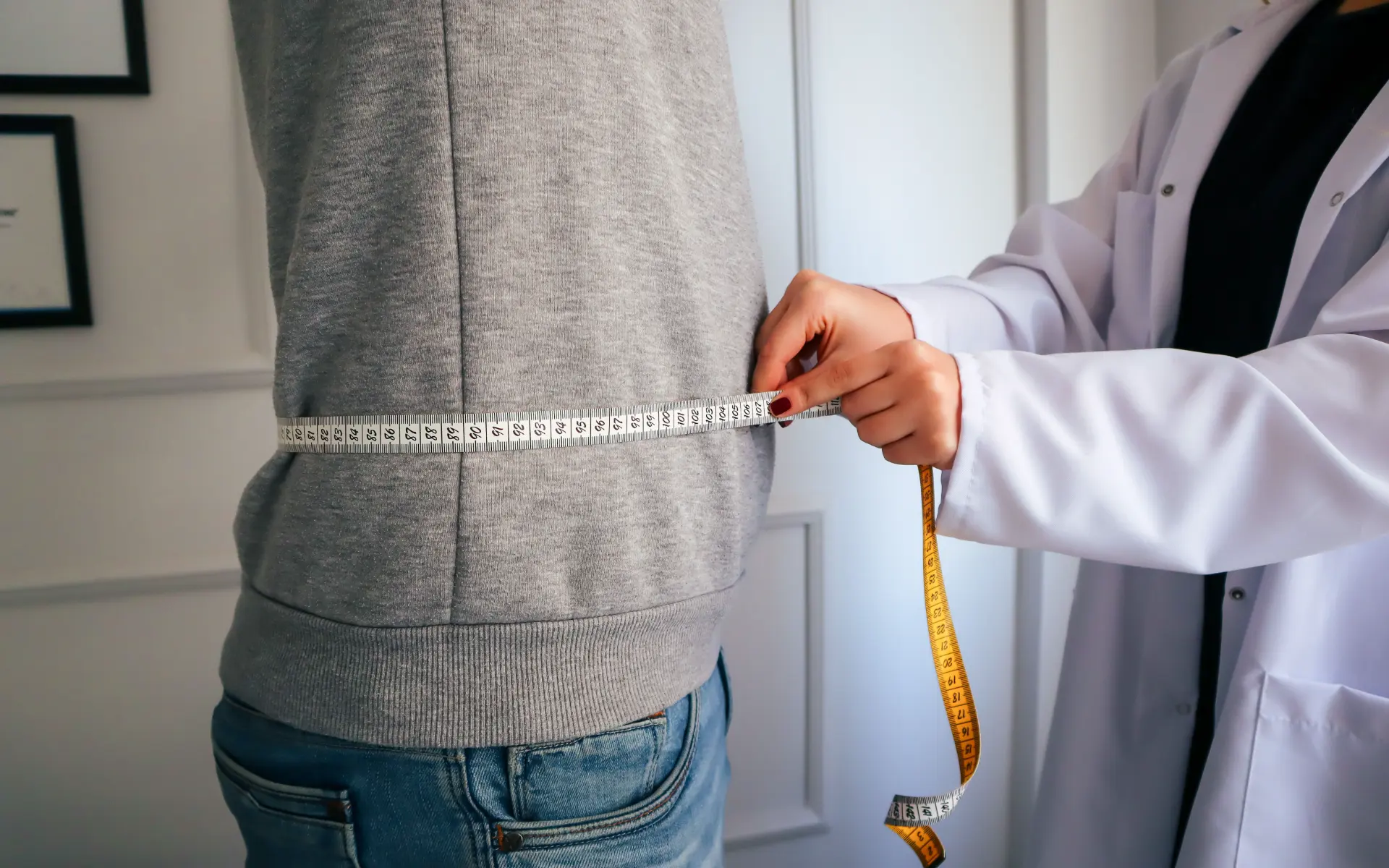
Predictive equations estimate lean mass from height and weight alone, so they cannot see how much muscle you actually carry, two people of identical size get identical answers. Measuring body fat with a tape and subtracting it is the more personal route.
This estimates lean body mass: everything you weigh that is not fat, including muscle, bone, organs and water.
It gives lean mass and fat mass separately, which is the split that matters when dieting.
What lean body mass is
Lean body mass is everything except fat: muscle, bone, organs, blood and water. A 70 kg man at 20% body fat has 56 kg of lean mass and 14 kg of fat.
It matters because lean mass is the part you want to keep. Weight loss always includes some lean tissue, and how much depends on how you go about it. A diet that loses 10 kg of which 3 kg is muscle is a much worse outcome than one that loses 8 kg of almost pure fat.
It is also a better basis than total weight for several other calculations. Protein targets, BMR via the Katch-McArdle equation, and some drug dosages all work from lean mass, because fat tissue has very different metabolic demands.
Two people at the same weight can differ by 15 kg of lean mass. That difference drives metabolic rate, strength and how the body looks.
What to enter
- Weight and height
- The Boer and Hume formulas estimate lean mass from these alone, which makes them convenient and approximate.
- Body fat percentage
- If you have a reliable figure, this is the accurate route: lean mass is simply weight × (1 − body fat).
- Sex
- Each formula uses different coefficients, reflecting average differences in body composition.
Ways to estimate lean mass
- From body fat percentage
- The most direct: weight × (1 − body fat). Only as good as the body fat estimate behind it.
- Boer formula
- Men: 0.407w + 0.267h − 19.2. Women: 0.252w + 0.473h − 48.3. Weight in kg, height in cm.
- Hume formula
- An older alternative giving broadly similar results.
- DEXA
- Measures rather than estimates, and reports lean mass by body region.
- Bioelectrical impedance
- Convenient and hydration-sensitive; readings drift with fluid balance.
What this assumes
Formula-based estimates use height and weight only, so they cannot distinguish a muscular person from a heavier one of the same size.
Lean mass includes water, which shifts by a kilogram or more day to day with hydration, carbohydrate intake and sodium.
How to calculate your lean body mass
If you know your body fat, use that. Otherwise apply the Boer formula.
- w
- Weight in kilograms
- h
- Height in centimetres
- women
- 0.252w + 0.473h − 48.3
Get a body fat estimate if you can. The circumference method is free and reasonably consistent. It gives a more personal answer than a height-weight formula.
Or apply the Boer formula. At 70 kg and 175 cm: (0.407 × 70) + (0.267 × 175) − 19.2 = 56.0 kg.
Subtract for fat mass. 70 − 56.0 = 14.0 kg of fat, which is 20.0% of body weight.
Use it where it belongs. Protein targets, Katch-McArdle BMR, and tracking what a diet is actually costing you.
See a worked example: two people, two compositions
- Man
- 70 kg, 175 cm
- Woman
- 60 kg, 165 cm
Man, Boer: (0.407 × 70) + (0.267 × 175) − 19.2 = 56.0 kg lean, so 14.0 kg fat, or 20.0%.
Woman, Boer: (0.252 × 60) + (0.473 × 165) − 48.3 = 44.9 kg lean, so 15.1 kg fat, or 25.2%.
Both sit in healthy ranges for their sex, and the percentages are not comparable across them.
For the man, a protein target at 1.8 g/kg of lean mass is 101 g, against 126 g on total weight. For someone carrying more fat, that gap widens considerably.
56.0 kg and 44.9 kg of lean mass
Frequently asked questions
- What is a good lean body mass?
There is no target figure, because it scales with height and frame. What matters is the proportion, which is body fat percentage, and whether lean mass is holding steady or falling.
During weight loss the goal is for lean mass to stay roughly flat while fat mass falls. That is a much more useful thing to watch than any absolute number.
- How do I keep lean mass while dieting?
Two things do most of the work: enough protein, around 1.8-2.2 g/kg, and continued resistance training.
The third is a moderate deficit. Aggressive deficits lose weight faster and take a larger share of it from muscle. 0.5-1% of body weight per week is the usual guidance.
- Should I use lean mass or total weight for protein?
Total weight is fine for most people and simpler. Lean mass is better if you carry substantial excess fat, since fat tissue has minimal protein requirement.
In the worked example the gap is 101 g against 126 g. For someone at 35% body fat, using total weight overestimates by considerably more.
- Why does my lean mass reading change day to day?
Because water is part of lean mass, and body water shifts by a kilogram or more with hydration, carbohydrate intake, sodium and menstrual cycle phase.
This is why smart scales appear to show muscle gained or lost overnight. Use the trend across weeks, not day-to-day readings.
- Is muscle mass the same as lean body mass?
No. Lean mass includes muscle, bone, organs, blood and water. Skeletal muscle is roughly half of it.
DEXA can separate them; formulas and impedance scales generally cannot. If a tool reports "muscle mass", check whether it means skeletal muscle or all lean tissue.
- How fast can I build lean mass?
Slowly, and slower the more trained you are. A beginner might gain 0.5-1 kg of muscle a month with good training and nutrition; an experienced lifter far less.
Anything faster than that is mostly water, glycogen and fat. Claims of rapid muscle gain almost always describe scale weight rather than lean tissue.
Problems people actually run into
Watching the scale instead of the split
Someone losing 8 kg with 3 kg of it lean tissue has a worse outcome than someone losing 6 kg of almost pure fat, and the scale reports the opposite.
Track lean mass alongside weight. If lean mass is falling steadily, raise protein, add resistance training, or reduce the deficit.
Trusting formula estimates for muscular people
Boer and Hume use only height and weight, so they cannot distinguish a lifter from a heavier sedentary person of the same size.
If you are visibly muscular or lean, use a body fat estimate instead, or a DEXA scan if the figure matters.
Results are estimates for general information only and are not professional financial, medical, or legal advice. Read our full disclaimer.
Sources
- Boer, Estimated lean body mass as an index for normalization of body fluid volumes, Am J Physiol 1984;247:F632-6 · National Library of Medicine (PubMed)
Last updated: September 13, 2026