Body Fat (U.S. Navy) Calculator
Estimate your body-fat percentage with the U.S. Navy tape method, and see the fat and lean mass behind it.
Your measurements
The tape method estimates body fat from circumferences; it is accurate to within about 3 percentage points against underwater weighing, and only if you measure consistently. DEXA is the reference standard if you need a real number.
This estimates body fat percentage from tape measurements using the US Navy circumference method.
It shows the percentage, the fat and lean mass in pounds or kilograms, and where the result sits against healthy ranges.
What body fat percentage means
Body fat percentage is the share of your body weight that is fat. It answers the question [BMI](/health/bmi-calculator) cannot: not how much you weigh, but what that weight is made of.
Two people at the same height and weight can be 12% and 30% body fat. BMI reports the same number for both. That difference is what actually relates to health and fitness.
The healthy ranges differ substantially by sex, and this is physiological rather than arbitrary. Essential fat is about 2-5% for men and 10-13% for women, because women carry additional fat required for hormonal and reproductive function. Comparing a woman's percentage against a man's range is a category error.
Women's ranges sit roughly 8-10 points higher throughout, reflecting essential fat requirements rather than any difference in fitness.
What to enter
- Height
- Without shoes. It appears in the formula as a logarithm and scales the whole result.
- Neck circumference
- Just below the larynx. It acts as a proxy for frame size, so a thicker neck lowers the estimate.
- Waist circumference
- The measurement that dominates the result. At the navel for men, at the narrowest point for women.
- Hip circumference
- Women only, at the widest point.
Ways of estimating body fat
- Circumference (Navy method)
- What this page uses. Free, repeatable, and typically within a few percentage points of a DEXA scan.
- Skinfold calipers
- More accurate with a skilled operator, and highly variable between operators.
- Bioelectrical impedance
- Smart scales and handheld devices. Convenient, and sensitive to hydration, so readings drift with fluid balance.
- DEXA
- Among the most accurate available, and it shows where the fat is distributed. Needs a scan appointment.
- Hydrostatic weighing and BodPod
- Very accurate; access is the limiting factor.
What this assumes
The circumference method infers fat from proportions rather than measuring it. Expect a few percentage points of error against a DEXA scan.
It is least reliable at the extremes: very lean, very muscular, or very high body fat.
How to calculate your body fat percentage
Measure with a tape, then apply the equation for your sex. The measuring is where the error lives, not the arithmetic.
- waist − neck
- In inches. This difference drives the result
- height
- In inches
- women
- Uses (waist + hip − neck) with different coefficients
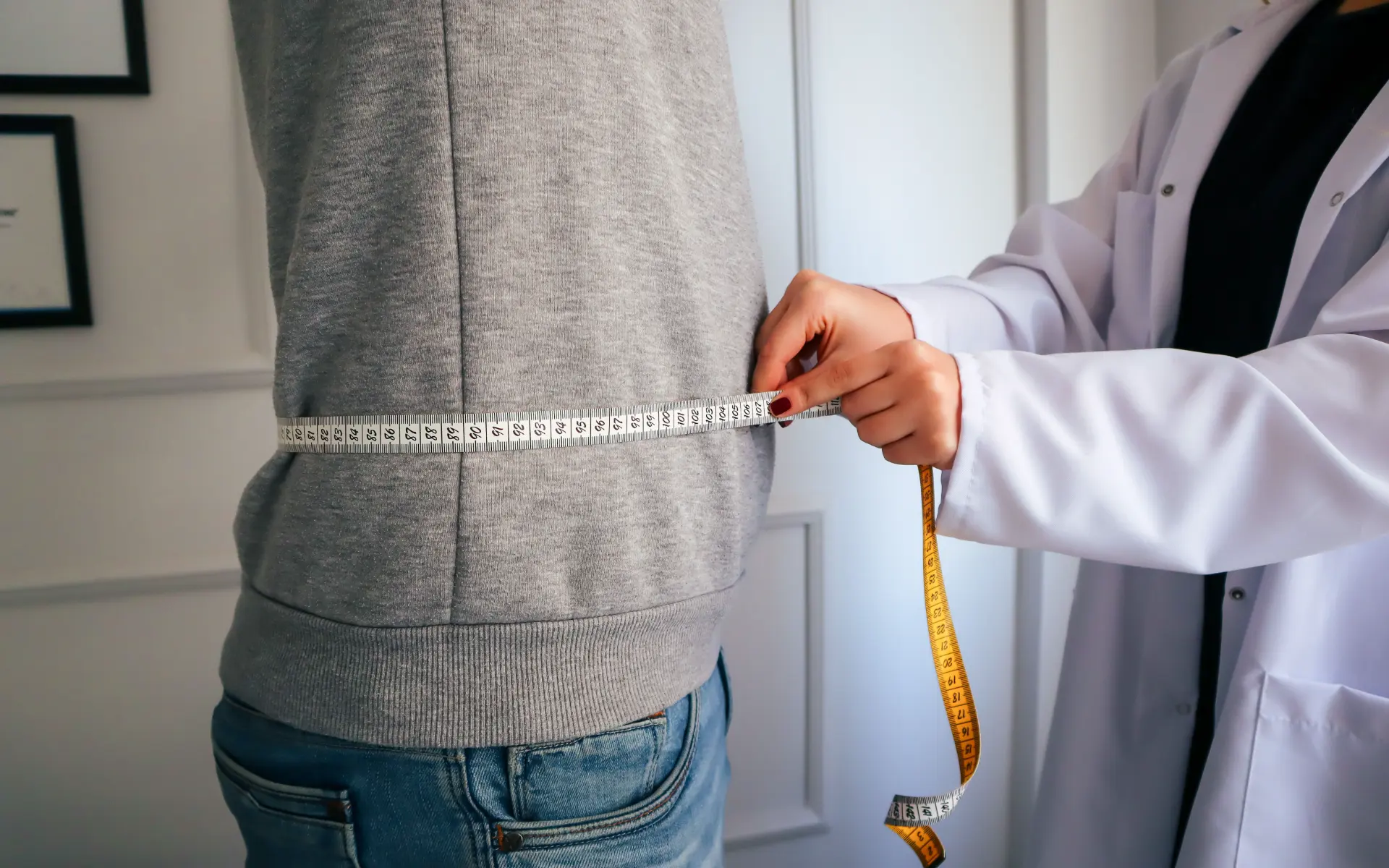
Measure at consistent landmarks. Neck below the larynx, waist at the navel for men and the narrowest point for women, hip at the widest point.
Keep the tape snug but not compressing. Measure at the end of a normal exhale, standing relaxed, against skin rather than clothing.
Average three measurements. Single readings are noisy. Averaging is the cheapest accuracy improvement available.
Convert to fat and lean mass. Percentage times body weight gives fat mass; the remainder is lean body mass, which is the figure to protect while dieting.
See a worked example: two worked measurements
- Man
- 38 in waist, 16 in neck, 70 in height
- Woman
- 32 in waist, 40 in hip, 13 in neck, 65 in height
Man: 86.010 × log₁₀(22) − 70.041 × log₁₀(70) + 36.76 = 23.0%, in the average range.
Woman: with waist + hip − neck = 59 in, the female equation gives 33.5%.
Both sit just above their respective average bands, which is the comparison that means something. Comparing the two figures directly does not.
For a 70 kg man at 20% body fat, that is 14.0 kg of fat and 56.0 kg of lean mass.
23.0% and 33.5%
Frequently asked questions
- What is a healthy body fat percentage?
For men, roughly 14-24% covers fitness through average. For women it is 21-31%, and that offset is physiological rather than a difference in fitness.
Below about 6% for men and 14% for women is athlete territory and difficult to sustain. Going near essential fat levels (2-5% men, 10-13% women) carries real health risk.
- Why are women's healthy ranges higher?
Because essential fat is higher: about 10-13% for women against 2-5% for men. It supports hormonal and reproductive function and is not optional.
A woman at 22% body fat is lean by any reasonable standard. Applying men's numbers to women produces targets that are unhealthy rather than ambitious.
- How accurate is the tape measure method?
Usually within a few percentage points of a DEXA scan, which is good for a free method requiring only a tape.
It is least accurate at the extremes of build. Its real strength is consistency: measured the same way each time, it tracks change reliably even if the absolute number is slightly off.
- Are smart scales accurate for body fat?
They are convenient and not very accurate. Bioelectrical impedance sends a small current through the body and infers composition from resistance, which is heavily affected by hydration.
The same person can read several points apart morning and evening. Weigh in under identical conditions and use the trend rather than any single reading.
- How fast can I lose body fat?
Roughly 0.5 to 1% of body weight per week is a sustainable rate that preserves muscle. Faster than that and an increasing share of the loss is lean tissue.
Two things protect muscle during a deficit: adequate protein, around 1.8-2.2 g/kg, and continued resistance training.
- Can I target fat loss in specific areas?
No. Spot reduction does not work; the body draws from fat stores according to genetics and hormones, not according to which muscle you trained.
Where you lose from first is largely outside your control. What you can control is total fat loss and building the muscle underneath.
Problems people actually run into
Comparing your figure against the wrong range
A woman at 24% body fat is in the fitness range. Held against men's numbers, the same figure reads as average or high.
The 8-10 point offset is essential physiology. Always compare against the range for your own sex.
Chasing a very low percentage
Single-digit body fat for men and mid-teens for women is competition condition, sustained for days rather than as a lifestyle.
Going too low costs hormonal function, sleep, mood and training performance, and in women it can stop menstruation entirely. The healthy ranges exist for a reason.
Results are estimates for general information only and are not professional financial, medical, or legal advice. Read our full disclaimer.
Sources
- Hodgdon & Beckett, Prediction of percent body fat from body circumferences and height, Report 84-11, 1984 · Naval Health Research Center
- Heart-Healthy Living: Aim for a Healthy Weight · National Heart, Lung, and Blood Institute (NIH)
Last updated: September 13, 2026