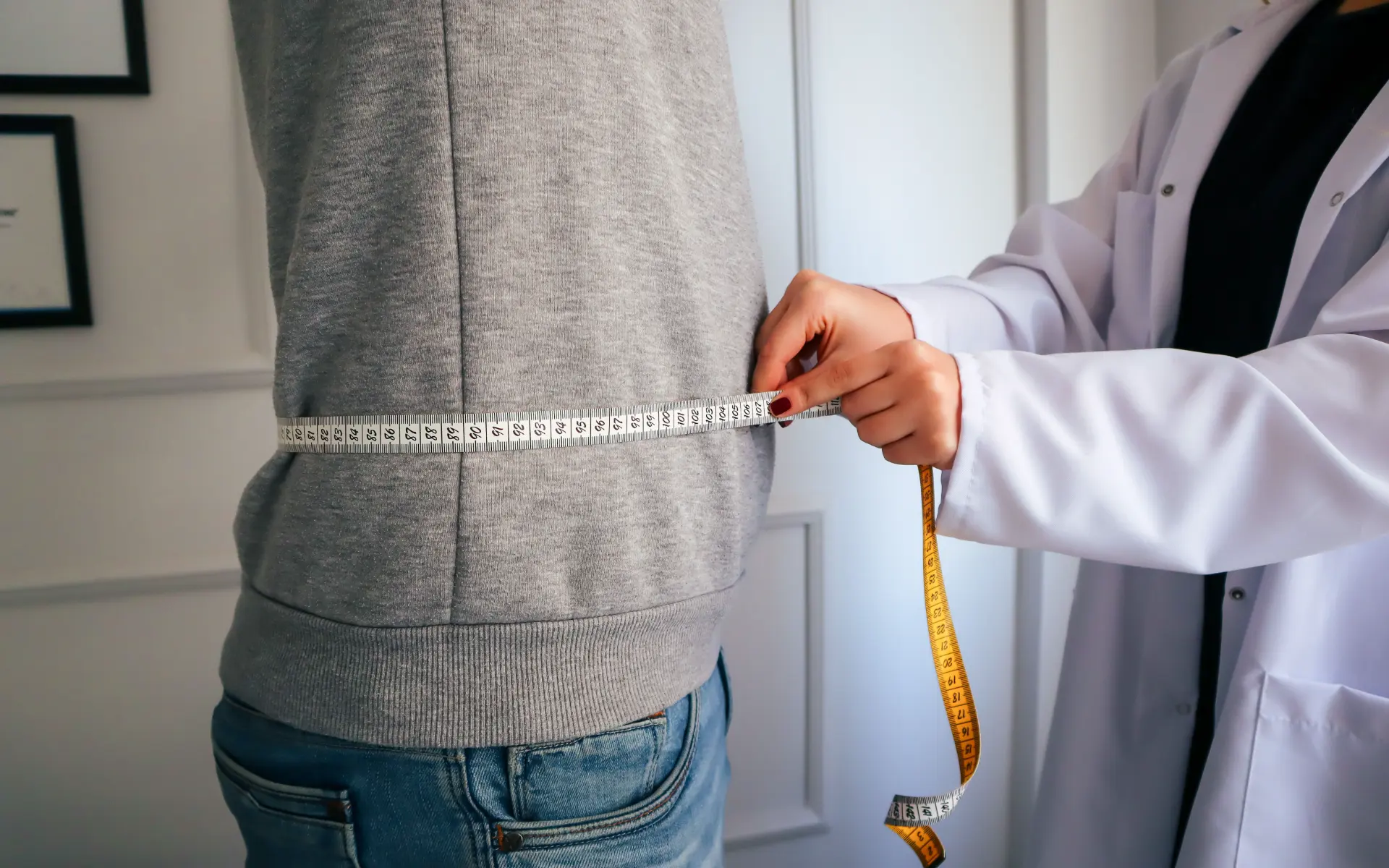
Waist-to-Hip Ratio Calculator
Measure abdominal fat with the WHO waist-to-hip ratio and the waist-to-height rule.
Your measurements
Where fat sits matters as much as how much there is. Fat around the organs (the kind a large waist signals), is more strongly linked to heart disease and type 2 diabetes than fat on the hips and thighs. This is a screening ratio, not a diagnosis.
This divides waist circumference by hip circumference to give waist-to-hip ratio.
It measures where your body stores fat, which is information BMI cannot provide.
What waist-to-hip ratio shows
Waist-to-hip ratio is waist circumference divided by hip circumference. A 32 in waist with 40 in hips gives 0.80.
What makes it worth measuring is that it captures where fat is stored, not how much there is. Fat around the abdomen, particularly the visceral fat packed around the organs, is metabolically active and carries considerably more cardiovascular and diabetes risk than the same amount of fat on the hips and thighs.
The WHO risk thresholds are 0.90 for men and 0.85 for women. Two people with an identical BMI and identical body fat percentage can sit either side of those lines, and their risk profiles genuinely differ.
Four inches of waist moves the ratio across the male risk threshold. Hip measurement barely changes for most adults, so the waist does nearly all the work.
What to enter
- Waist circumference
- At the narrowest point, usually just above the navel. Measured at the end of a normal exhale, without holding your stomach in.
- Hip circumference
- At the widest point of the buttocks, with the tape level all the way round.
WHO risk categories
- Men: below 0.90
- Low risk. Above 0.90 is associated with substantially increased metabolic risk.
- Women: below 0.85
- Low risk. Above 0.85 carries increased risk.
- Waist circumference alone
- Also a strong indicator, and simpler. Commonly flagged above 40 in for men and 35 in for women.
- Waist-to-height ratio
- Keeping your waist under half your height. Simple, well supported, and works across body sizes without sex-specific thresholds.
What this assumes
Circumference is a proxy for visceral fat, not a measurement of it. Imaging is the only way to measure it directly.
Thresholds vary by population. Some guidelines use lower cut-offs for people of South and East Asian ancestry, where risk rises at smaller measurements.
How to calculate your waist-to-hip ratio
One division, and the measuring matters more than the arithmetic.
- waist
- At the narrowest point, above the navel
- hip
- At the widest point of the buttocks
Measure the waist correctly. At the narrowest point, at the end of a normal exhale, standing relaxed. Do not hold your stomach in.
Measure the hips at the widest point. Keep the tape level all the way round. This is easier with a mirror.
Divide waist by hips. 32 ÷ 40 = 0.80. Units do not matter as long as both use the same.
Compare against the threshold for your sex. 0.90 for men, 0.85 for women. Track it over time rather than reading one measurement too closely.
See a worked example: how much four inches matters
- Hips
- 40 in, unchanged
- Waist
- 32 in, then 36 in
32 ÷ 40 = 0.80, comfortably below both thresholds.
36 ÷ 40 = 0.90, which is at the male threshold and well above the female one.
Hip measurement changes very little for most adults, so the waist drives almost all the movement.
That also makes it a good progress marker: waist circumference responds to fat loss faster and more visibly than the scale does.
0.80 and 0.90 from the same hips
Frequently asked questions
- What is a healthy waist-to-hip ratio?
The WHO thresholds are below 0.90 for men and below 0.85 for women. Above those, risk of cardiovascular disease and type 2 diabetes rises measurably.
Some guidelines use lower cut-offs for people of South and East Asian ancestry, where metabolic risk appears at smaller measurements.
- Why does fat distribution matter more than total fat?
Because visceral fat, stored around the organs, behaves differently from fat under the skin. It is metabolically active, releasing inflammatory signals and free fatty acids straight into the portal circulation.
That is why abdominal fat is more strongly associated with insulin resistance and cardiovascular disease than the same quantity of fat on the hips and thighs.
- Is WHR better than BMI?
It measures something different rather than something better, and the two work well together. BMI captures overall size; WHR captures distribution.
Several large studies have found waist measurements predict cardiovascular risk better than BMI alone. Someone with a normal BMI and a high WHR can carry real metabolic risk, which BMI would miss entirely.
- Where exactly should I measure my waist?
At the narrowest point, usually just above the navel. Some protocols use the midpoint between the lowest rib and the top of the hip bone.
What matters most is consistency: use the same landmark every time. Measure at the end of a normal exhale, without holding your stomach in.
- Can I reduce abdominal fat specifically?
Not by targeting it directly. Spot reduction does not work, and abdominal exercises build the muscle underneath without removing the fat over it.
The encouraging part is that visceral fat responds relatively well to an overall calorie deficit and regular exercise, often faster than subcutaneous fat does.
- What is waist-to-height ratio?
Waist divided by height, with a simple rule: keep your waist under half your height.
It needs one fewer measurement than WHR, works across different body sizes, and does not need separate thresholds by sex. Some researchers argue it is the better single screening measure.
Problems people actually run into
Measuring inconsistently
Holding your stomach in, measuring after a large meal, or using a different landmark each time can all shift the waist figure by an inch or more.
That inch moves the ratio by about 0.025, which is a quarter of the way to the next category. Same time of day, same landmark, same relaxed posture, every time.
Assuming a normal BMI means no risk
Someone with a BMI of 23 and a waist-to-hip ratio of 0.95 carries real metabolic risk that BMI does not show. It is common enough to have its own informal name: normal weight obesity.
Measure the waist as well. It takes thirty seconds and catches something the scale cannot.
Results are estimates for general information only and are not professional financial, medical, or legal advice. Read our full disclaimer.
Sources
- Waist circumference and waist-hip ratio: report of a WHO expert consultation, 2008 · World Health Organization
Last updated: September 13, 2026